Well, are you?
I am. Stuck on horses that is. It feels like the last million blogs have all featured horses. In reality it only been three or four. Most of them aren't even on this website. But there is a valid reason for that.
The reason does have something to do with me learning to draw via horses. And I guess that could make me bias. However I feel strongly that they help, so I'm going to give you them.
When I learn't, and hopefully when you learn from me, we use the circle method. Oh no! Not more circles. I know, I know, I have gone a bit over the top with the bloody circles, but just bare with me.
You see, as I have said, (a lot)the circles are there to represent something. In my last blog that was a part of the horse, like a shoulder, or a knee. But recently I was giving a impromptu art lesson to a 11 year old, when they taught me a very important thing.
It wasn't a skill, so much as how to see a lack of one. Let me explain my self.
This girl had just drawn a very interesting mermaid (and no, it wasn't a mermaid-horse). I took one look at this mermaid and thought, she has done it wrong.
I noticed first up that she obviously knew what a waist was, as the creature had one. However it looked as though she didn't know why it was there.
I drew a picture of some bones, and showed her why the waist dipped in at the middle. Of course, she already knew this and I had just wasted several precious minutes of her attention span.
So the next problem I attempted to fix was the lack of definition in the arms of the underwater deity.
And it was at this point that I finally figured out what the problem was. Because she said, after I drew her a skinny arm with shape, "I prefer girls without muscles."
Then I lost her attention and she left.
Girls have muscles. They do. Otherwise we would be incapable of moving. We also have bones, and fat. And when you draw something, be it a mermaid, horse or dog, you have to take into account the effect these under skin structures.
That is one of the reasons that in step by step drawings the shapes are present. They are a simplified way of showing the budding artist the effect of the main structures of bone or muscle in the creature we are drawing.
You can't just draw what you think the outline would look like with out taking everything else into account, because it will never work.
Tuesday, March 16, 2010

Monday, March 15, 2010
How to Daw a Simple Horse
Hi everyone!
I have been getting requests to hurry up and make some tutorials already. So I did. Hope you guys like horses...
How to Draw a Simple Horse
Step 1:

All these steps are equally simple. Just because this is step one, does not mean that the other steps will be harder. The only skills this tutorial needs is patience and a pencil.
If your circles don't turn out the way mine did, don't worry. This bit of the tutorial is aloud to be rough. Just continue to draw circles quickly on your page. Eventually the mass of circles will add up to look right.
Keeping in mind what the circles and lines in this tutorial represent is good practice. Many tutorials don't tell you to do this, but I believe that it is very important. Remember that the circles and lines of the first four steps are just representations of the horses body. In the final step you can discard a piece completely if it doesn't fit into how you think the outline of your horse should look.
Step 2:
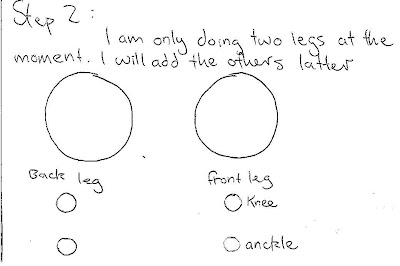 A good technique at this point is to visualise the out line of your finished horse over the circles you have drawn. This way you don't need to worry about putting a circle in the wrong place.
Many people, myself included, when copying a step by step tutorial like this one, feel that they need to place the circles in the exact same position as the tutorial artist has placed theirs.
In my opinion that is not drawing, it is tracing. You will get much more satisfaction if you visulise the finished
horse and put the circles inside the visualisation. This way you are least likely to have to change the positions of circles before the final step.
Step 3:
 Remember, the key to getting the head in the right position is to visualise a horse over the circles.
Sometimes it helps to have a picture of a horse that you can refer to.
 At this point if you don't already have a picture of a horse for reference, it is time to go find one. Google images is great for this, as long as you don't break copyright on anyone's photos.
Notice that I haven't stuck directly to the circles. They are just a general guide line to where the horse is.
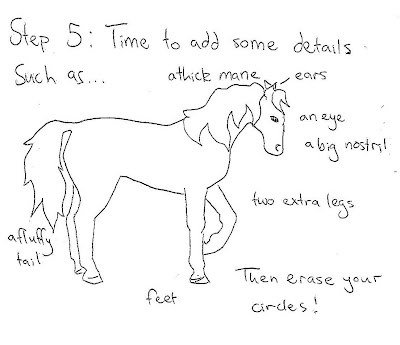 Excuse my rushed drawings. However this tutorial, I hope, will give you a rough idea on how to draw a horse. The circles can be manipulated to put your horse in different positions. However because the horse is drawn side on, it can be difficult for a beginner to change the view point to, say, a horse facing us. Let me know if you would like to see any tutorials on horses in different positions and I will see what I can do. :)
If you are having difficulty drawing the details from my drawing, never fear, another tutorial on details will be on the website soon.
I have been getting requests to hurry up and make some tutorials already. So I did. Hope you guys like horses...
How to Draw a Simple Horse
Step 1:

All these steps are equally simple. Just because this is step one, does not mean that the other steps will be harder. The only skills this tutorial needs is patience and a pencil.
If your circles don't turn out the way mine did, don't worry. This bit of the tutorial is aloud to be rough. Just continue to draw circles quickly on your page. Eventually the mass of circles will add up to look right.
Keeping in mind what the circles and lines in this tutorial represent is good practice. Many tutorials don't tell you to do this, but I believe that it is very important. Remember that the circles and lines of the first four steps are just representations of the horses body. In the final step you can discard a piece completely if it doesn't fit into how you think the outline of your horse should look.
Step 2:

Many people, myself included, when copying a step by step tutorial like this one, feel that they need to place the circles in the exact same position as the tutorial artist has placed theirs.
In my opinion that is not drawing, it is tracing. You will get much more satisfaction if you visulise the finished
horse and put the circles inside the visualisation. This way you are least likely to have to change the positions of circles before the final step.
Step 3:
 Remember, the key to getting the head in the right position is to visualise a horse over the circles.
 Sometimes it helps to have a picture of a horse that you can refer to.
Step 4:
 At this point if you don't already have a picture of a horse for reference, it is time to go find one. Google images is great for this, as long as you don't break copyright on anyone's photos.
Notice that I haven't stuck directly to the circles. They are just a general guide line to where the horse is.
Step 5:
 Excuse my rushed drawings. However this tutorial, I hope, will give you a rough idea on how to draw a horse. The circles can be manipulated to put your horse in different positions. However because the horse is drawn side on, it can be difficult for a beginner to change the view point to, say, a horse facing us. Let me know if you would like to see any tutorials on horses in different positions and I will see what I can do. :)
If you are having difficulty drawing the details from my drawing, never fear, another tutorial on details will be on the website soon.
Thanks for viewing guys!
I hope you can now draw a horse like this one.
Cheers
Meg
Sunday, December 20, 2009
What Art Looks Good?
So many people buy art to complete their homes. To add colour. To impress. But I don't think that's what art is about.
When a artist creates something, they give it meaning. Even if it started out as a business venture, the painting grows in the mind of the artist. Why? Mainly because of the time spent on it. Anything that takes up enough of your time becomes something important.
Because it is taking up so much of the artists time, it may as well be perfect. The details have to look just right. The forms and colours need to look like they are supost to be there. The piece has to look whole.
And as you can imagine, all this effort and time leads to a certain amount of love for a painting. If one puts in this amount of effort in to creating something it is natural to feel it is important. If it where to be destroyed it would be a major set back. Nothing like it will ever be created again. Even if you make a copy, small details will be chainged. A time of many hours of hard work, completely wasted.
So when a artist sells their work it is natural to feel some regret. Regret that they may not see the original again, regret that they can nolonger look on it and feel proud.
And, you, the buyer may not understand all this. That is perfectly natural. After all, it wasn't you that made it. All the same it is strange that so many people choose art because it matches the colour of their sofa. I'm not discriminating, harmonious colours are certainly soothing. So I can understand the theory behind this particular choice.
All the same, I believe that if you are going to buy something as visual and as long lasting as a piece of artwork, shouldn't it be chosen on how much you enjoy looking at it? Isn't that what artwork is for?
If you truly enjoy and love the piece, it is a kind of relief for the artist. Knowing that the painting is going to a good home, is a similar feeling to making sure your puppy is going to good owners. The artist feels that, despite them not being able to see their own work, at least some one else is viewing it with the same love. At least it is being appreciated as the masterpiece it truly is.
cheers
meg
When a artist creates something, they give it meaning. Even if it started out as a business venture, the painting grows in the mind of the artist. Why? Mainly because of the time spent on it. Anything that takes up enough of your time becomes something important.
Because it is taking up so much of the artists time, it may as well be perfect. The details have to look just right. The forms and colours need to look like they are supost to be there. The piece has to look whole.
And as you can imagine, all this effort and time leads to a certain amount of love for a painting. If one puts in this amount of effort in to creating something it is natural to feel it is important. If it where to be destroyed it would be a major set back. Nothing like it will ever be created again. Even if you make a copy, small details will be chainged. A time of many hours of hard work, completely wasted.
So when a artist sells their work it is natural to feel some regret. Regret that they may not see the original again, regret that they can nolonger look on it and feel proud.
And, you, the buyer may not understand all this. That is perfectly natural. After all, it wasn't you that made it. All the same it is strange that so many people choose art because it matches the colour of their sofa. I'm not discriminating, harmonious colours are certainly soothing. So I can understand the theory behind this particular choice.
All the same, I believe that if you are going to buy something as visual and as long lasting as a piece of artwork, shouldn't it be chosen on how much you enjoy looking at it? Isn't that what artwork is for?
If you truly enjoy and love the piece, it is a kind of relief for the artist. Knowing that the painting is going to a good home, is a similar feeling to making sure your puppy is going to good owners. The artist feels that, despite them not being able to see their own work, at least some one else is viewing it with the same love. At least it is being appreciated as the masterpiece it truly is.
cheers
meg
Crunch time
Ok, so here's the deal. We have all come to this web site with one thing on our mind, and that's art. So what do you guys want to see? I have links to any work I'm selling. Do you guys want links to work you're selling? How about tutorials? I'm thinking of making a few of them. And more articles? Give me some ideas? I'm open to suggestion.
This web site is for you guys. Tell me what you want on it.
Don't be shy about flicking me emails.
megan.styles@gmail.com
Or just leave comments.
cheers
meg
This web site is for you guys. Tell me what you want on it.
Don't be shy about flicking me emails.
megan.styles@gmail.com
Or just leave comments.
cheers
meg
Friday, December 18, 2009
How to Draw
I know that some of you may have already read this article, but for those that haven't, here it is;
Drawing well is something that the majority of people will never accomplish. To many this puts art in the realm of a innate ability. I can see why. If you can only draw stick figures, there is a good chance that when your mate whips out the canvas you feel decidedly inferior. "How do you do that??" The friend shrugs non-committally. "I just can."
According to your artist friends answer, drawing is something that you are just born knowing how to do. And there is some merit in this statement, for all its invalidism. It does seem that some people pick up the concept of art faster than others; Those people who were never formally taught, yet can create master pieces with a paintbrush.
However these 'gifted' people are for the most part entirely like those who cannot presently draw. If you look at their drawings from early childhood, you will notice that they are directly comparable to another child's creation. The untutored artist had to start somewhere.
I believe then, that the difference in ability that appears later in the child's life, comes not from a subconscious gift from the heavens, but from a much simpler source. These children that become artist have more of interest in art than their peers. When the other children are kicking soccer balls or reading books, they are drawing endless pictures.
Practice makes perfect they say, and this is shown in all its glory when the child grows up... and whips out the canvas.
cheers
meg
Drawing well is something that the majority of people will never accomplish. To many this puts art in the realm of a innate ability. I can see why. If you can only draw stick figures, there is a good chance that when your mate whips out the canvas you feel decidedly inferior. "How do you do that??" The friend shrugs non-committally. "I just can."
According to your artist friends answer, drawing is something that you are just born knowing how to do. And there is some merit in this statement, for all its invalidism. It does seem that some people pick up the concept of art faster than others; Those people who were never formally taught, yet can create master pieces with a paintbrush.
However these 'gifted' people are for the most part entirely like those who cannot presently draw. If you look at their drawings from early childhood, you will notice that they are directly comparable to another child's creation. The untutored artist had to start somewhere.
I believe then, that the difference in ability that appears later in the child's life, comes not from a subconscious gift from the heavens, but from a much simpler source. These children that become artist have more of interest in art than their peers. When the other children are kicking soccer balls or reading books, they are drawing endless pictures.
Practice makes perfect they say, and this is shown in all its glory when the child grows up... and whips out the canvas.
cheers
meg
Why Art?
I know that some of you may have seen this article, but for those who haven't, here it is;
Art has been a major part of human civilisation for thousands of years and has been a huge part of millions of lives. It can earn a living, communicate thoughts and feelings and relieve stress. If you have inborn ability, if you learned how or if you can't draw stick figures, art is still a powerful force in everyone's lives.
Art has so many levels. From what started as drawings of animals on cave walls has developed into a multi-faceted industry that comprises of hundreds of categories of different media's and styles. Abstract acrylic painting to sculptures of angels, all art is powerfully attractive to the human psyche.
If offered a visit to an ancient cave drawing site, nobody would refuse. I can guarantee that. Why? Because art pulls at emotions and as humans we are hard wired to respond to visual emotional triggers. Monkeys know if a fruit is ripe by how the colour effects them. Just as art makes us feel certain emotions because of its form.
When you walk into that cave, the shapes on the wall are meaningful to you in a way that they could never be to any other creature on this planet. Where you see a horse, they see a splash of colour. That is why art is to important to so many people. Subconsciously they all understand that art is what sets us above and beyond animals. They may be beautiful enough to warrant painting, but we are the only ones who can create the painting, and we are defiantly the only ones who can appreciate it.
Stories and legends from all over the world attempt to explain why we were given conscience and animals were not. Millions of people wonder what is our purpose. I think the answer is very simple. It is to appreciate our surroundings in a way that nothing else can. To appreciate the oceans and skies as something worth capturing forever in paint, as something beautiful.
Art effects each and everyone of us in profusion of ways. No matter what the form or shape, no matter who the person, the effect will be there. You just need to look.
cheers
meg
Art has been a major part of human civilisation for thousands of years and has been a huge part of millions of lives. It can earn a living, communicate thoughts and feelings and relieve stress. If you have inborn ability, if you learned how or if you can't draw stick figures, art is still a powerful force in everyone's lives.
Art has so many levels. From what started as drawings of animals on cave walls has developed into a multi-faceted industry that comprises of hundreds of categories of different media's and styles. Abstract acrylic painting to sculptures of angels, all art is powerfully attractive to the human psyche.
If offered a visit to an ancient cave drawing site, nobody would refuse. I can guarantee that. Why? Because art pulls at emotions and as humans we are hard wired to respond to visual emotional triggers. Monkeys know if a fruit is ripe by how the colour effects them. Just as art makes us feel certain emotions because of its form.
When you walk into that cave, the shapes on the wall are meaningful to you in a way that they could never be to any other creature on this planet. Where you see a horse, they see a splash of colour. That is why art is to important to so many people. Subconsciously they all understand that art is what sets us above and beyond animals. They may be beautiful enough to warrant painting, but we are the only ones who can create the painting, and we are defiantly the only ones who can appreciate it.
Stories and legends from all over the world attempt to explain why we were given conscience and animals were not. Millions of people wonder what is our purpose. I think the answer is very simple. It is to appreciate our surroundings in a way that nothing else can. To appreciate the oceans and skies as something worth capturing forever in paint, as something beautiful.
Art effects each and everyone of us in profusion of ways. No matter what the form or shape, no matter who the person, the effect will be there. You just need to look.
cheers
meg
Tuesday, December 15, 2009
Mixing Media
Are you stuck in a rut? No inspiration when you pick up the same old coloured pencils and stare at the blank piece of plain white paper in front of you? Well I have a fantastic solution to your art block woes. Mixing media!
And no, I'm not talking about mixed media, and have made a typo. Mixing media is making a temporary change to another art material. I started love affair with art by drawing pictures with coloured pencil. I got pretty good at it to. However it limited what I could create.
The media you use will naturally affect your art style. When I draw in coloured pencil I focus more on details and tend to dislike creating backgrounds because it is time consuming to create large blocks of colour.
The main reason I was restricted to pencil was because it was comfortable. I had never really tried anything else. My only experiences with any other media was painting in art class at school. And I was never very good at that. Everything else was outside my comfort zone.
I would pick up a paint brush and almost be to afraid to place it on the canvas or paper. The fear of stuffing up and wasting the paint or the paper was to acute to overcome. I felt that because my earlier attempts at painting were not as good as some of my coloured pencil drawings, I couldn't ever create any thing good with paint. However I just had to get over it and try. Intellectually I knew that I would only ever improve if I practised.
There was a photo of a horse on my wall(The same you see at the top of the page.). I found it so beautiful I had to draw it. However the beauty was in the colours and not in the shape. If I was to get this out of my system I was going to have to paint it, as paint gives much more intense colours than pencil.
As soon as I started I realised that the effects of the art book had improved more than just my pencil abilities. With this small success under my belt I suddenly found it much easier to experiment with different media's. Soon I tried pastel. And have never looked back. My first few were horrid, but with practice I managed to create the kelpie dog you see here.

Trying a new way of creating art can help spark your enthusiasm for drawing or sculpting all over again. It's like discovering pens when you were a young child and being endlessly fascinated by the colour coming out of the end of the piece of plastic griped in you chubby fingers.
Your drawing skills improve exponentially because of the different styles you need to try to get the new media to work for you and art block mysteriously vanishes. Art no longer is some thing you can do... It becomes some thing you can create.
And no, I'm not talking about mixed media, and have made a typo. Mixing media is making a temporary change to another art material. I started love affair with art by drawing pictures with coloured pencil. I got pretty good at it to. However it limited what I could create.
The media you use will naturally affect your art style. When I draw in coloured pencil I focus more on details and tend to dislike creating backgrounds because it is time consuming to create large blocks of colour.
The main reason I was restricted to pencil was because it was comfortable. I had never really tried anything else. My only experiences with any other media was painting in art class at school. And I was never very good at that. Everything else was outside my comfort zone.
I would pick up a paint brush and almost be to afraid to place it on the canvas or paper. The fear of stuffing up and wasting the paint or the paper was to acute to overcome. I felt that because my earlier attempts at painting were not as good as some of my coloured pencil drawings, I couldn't ever create any thing good with paint. However I just had to get over it and try. Intellectually I knew that I would only ever improve if I practised.
There was a photo of a horse on my wall(The same you see at the top of the page.). I found it so beautiful I had to draw it. However the beauty was in the colours and not in the shape. If I was to get this out of my system I was going to have to paint it, as paint gives much more intense colours than pencil.
As soon as I started I realised that the effects of the art book had improved more than just my pencil abilities. With this small success under my belt I suddenly found it much easier to experiment with different media's. Soon I tried pastel. And have never looked back. My first few were horrid, but with practice I managed to create the kelpie dog you see here.

Trying a new way of creating art can help spark your enthusiasm for drawing or sculpting all over again. It's like discovering pens when you were a young child and being endlessly fascinated by the colour coming out of the end of the piece of plastic griped in you chubby fingers.
Your drawing skills improve exponentially because of the different styles you need to try to get the new media to work for you and art block mysteriously vanishes. Art no longer is some thing you can do... It becomes some thing you can create.
Subscribe to:
Posts (Atom)

